Wednesday, November 13, 2013

COMMUNITY COLLEGES KEY IN VIRGINIA GOVERNOR ELECTION

Governor elect Terry McAuliffe.   Source: wiki commons
On November 5, Terry McAuliffe, prominent Clinton fundraiser defeated Attorney General Kenneth Cuccinelli on November 5 in hotly contested Governor’s race in Virginia.  McAuliffe highlighted community colleges as a critical resource to prepare Virginians for employment and expand the state’s economy. 

Reporting on the Virginia election, the New York Times noted on November 6, “"Mr. McAuliffe ran a disciplined campaign, touring all 23 community colleges in the state to highlight work force development and keeping his message tightly on job creation."

According to the October 9th Washington Times, McAuliffe pledged to increase funding for community colleges. “Mr. McAuliffe has noted a roughly $1,900 gap between in per-student state funding for community colleges in 2008 and now. Restoring the funds would cost the state $900 million over four years.”
Virginia Attorney General Kenneth Cucinelli.
Source: Wikipedia

Virginia’s highly regarded public higher education universities did not figure prominently in the campaign.  In contrast McAuliffe used support for community colleges as a vehicle to attract voters and convince them that he was serious about expanding economic opportunity.

With their appeal to moderate and low-income voters and wide geographic distribution, a focus on community colleges could become a staple in future state electoral campaigns.   


Tuesday, October 22, 2013

IS HIGHER EDUCATION A LEVELER OR BARRIER OF SOCIAL MOBILITY


Higher Education defenders like to make the claim that higher education is a great leveler in our society.  One does not have to be born into wealth and privilege, the argument goes, to earn a college degree that leads to a lifetime of earnings and respect. 

My own story reflects the power of higher education to transform lives.  My mother, the eldest daughter of a widow, went to work in a handbag factory immediately after graduating high school.  My father’s whose education stopped after the eighth grade worked on a family farm.  However, their children all went to college as did my most of my cousins.  As a result my siblings and cousins became teachers, psychologists, lawyers, city planners, scientists, and engineers. 

Unfortunately, upward mobility in the US via higher education is becoming more and more rare as selective colleges preferentially admit students from higher income brackets and students from poor and working class backgrounds are sent to community colleges and other open admission institutions.

The goal of a bachelor’s degree for those in lower social economic brackets and especially Hispanic and African Americans has taken a huge step backwards during the Great Recession.  In fact, one can argue, that higher education has now become a mechanism for re-enforcing class and racial divisions rather than providing opportunity for upward mobility. 

What is the evidence? Most compelling is a new report Separate and Unequal by Anthony Carnevale and Jeff Strohl of Georgetown University’s Center on Education and the Workforce.  The subtitle of the report, How Higher Education Reinforces the Intergenerational Reproduction of White Racial Privilege, captures the findings.  The chart below gives a visual summary of their data based on examining the post-secondary enrollment of all US students in the decade 1995 to 2005.


While these developments mirror the increasing racial and financial divide in our country, higher education may be more amenable to change and influence than other drivers of US inequality.  For those of us working in higher education, our challenge is to reform our institutions to make them drivers of equality and upward mobility rather than re-enforces of the status quo.  Because of the increasing importance of post-secondary education for an individual’s future earnings and economic viability, our success in this endeavor will have profound effects for the future of US society.


Thursday, July 25, 2013

THE ELEPHANT OF INDOSTAN

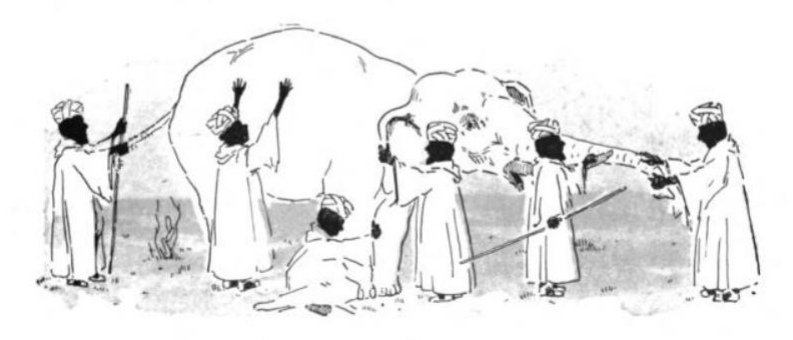
Perspectives are manifold on what should be done to reform and improve higher education in the United States.  And those attitudes depend on one's view of this important component of America’s education system.  Some argue that American higher education is fundamentally sound and others that it is unsustainable because of increasing costs. Viewpoints are so varied that it seems that individuals are talking about different subjects, much like the story of the blind men who touch the elephant immortalized in John Godfrey Saxe's (1816-1887) version of the famous Indian legend:

It was six men of Indostan
To learning much inclined,
Who went to see the Elephant
(Though all of them were blind),
That each by observation
Might satisfy his mind.

The story is based on old legends from the Indian subcontinent that demonstrate that each person brings his/her own prejudices and perspectives (blind spots) in examining an issue, as the blind men do, with vastly different conclusions.  One blind man, examining the ears, thinks the elephant is a fan, the blind man touching the leg thinks he has found a tree trunk and so on.   

Six blind men examine an elephant.  Source: Wikipedia
           

According to a numerous polls, the US public thinks that obtaining a post-secondary degree is essential to one’s future.  For example the 2013 report by Sallie Mae, How America Pays for College, cites “Unwavering belief in the value of college” with “85% of parents strongly agreed that college was an investment in their child’s future, the highest in the last five years.”

However, the cost of college is a concern for many.  The 2012 report of the Pew Charitable Trust says, “75% of public says college too expensive for most Americans to afford.”  
And even more troubling according to Pew, “57% of Americans say colleges fail to provide students with good value for money spent.”

A college degree that has proven to be, for most, the key to economic security, is becoming a birth right for the rich but out of reach for many in the middle and poorer classes. This fact has been documented by the HamiltonProject that reports, “College graduation rates have increased sharply for wealthy students but stagnated for low-income students.”  Moreover, the Hamilton Project also informs us that, not surprisingly, “the most-competitive colleges are attended almost entirely by students from higher-socioeconomic status households.”

So how is the elephant doing?  Clearly, US higher education with its world-class institutions is serving the wealthy very well but not the rest of America who sees higher education degree as essential, expensive and difficult to attain.

Friday, June 14, 2013

THE TEN PER CENT SOLUTION

 
Uiversity of  Oxford Keble College Chapel as viewed across the quadrangle in Oxford, England.  Oxford is thought to be the model for Christminster College in Hardy's Jude the Obscure. Source: Wikipedia
In his remarkable book, Jude the Obscure, novelist Thomas Hardy paints a painful picture of Jude, a young man in late nineteenth century England who tries to break class barriers by entering Christminister College.

“Only a wall divided him from those happy young contemporaries of his with whom he shared a common mental life; men who had nothing to do from morning till night but to read, mark, learn, and inwardly digest. Only a wall—but what a wall!” 

In twenty-first century America, we have a related problem.  Young people of modest means feel excluded from higher education, especially elite colleges and universities.  While eight million find their way to community colleges, there is often no clear and compelling path to a baccalaureate degree.  Moreover while some senior institutions actively recruit community college students, many exclude them.  And those that do accept community college transfers usually provide little support, academically and financially.

I therefore offer the following proposal and challenge to all bachelor degree granting institutions: open your doors to recruit and accept community college transfers in the number of ten per cent of your junior class.  By doing so approximately 200,000 community college students will be admitted to four year colleges and institutions, bolstering the number of bachelor degree graduates in our country. 

This proposal is not entirely new. Some private elite institutions such as Smith , Amherst  and Mount Holyoke Colleges where I live in Western Massachusetts have been recruiting community college students for decades.  And these schools have set aside special financial aid to enable community college transfers to afford the high tuition costs.  Outgoing Smith College President Carol Christ told me that the Ada Comstock program at Smith dedicated to community college transfers is attractive to Smith alumnae because they understand that their contribution goes twice as far.  Why? Because entering as juniors, these transfers have to be supported for only two years of undergraduate education.

Elite private colleges and universities have been criticized for their privileged position in American society.  These institutions draw their undergraduates primarily from the advantaged and therefore, their campuses are not reflective of the socio-economic or ethnic profile of our society.  As non-profits they enjoy substantial tax advantages: their donors are shielded from federal taxes and their campuses are exempt from property taxes.  Finally, these schools, especially the private research universities, receive substantial federal government funds in the way of grants and research contracts.

By opening their doors to community college students four year colleges, especially the private elites, will make their student body more diverse creating a better educational environment for their traditional students.  Moreover, their tax exempt status is predicated on the assumption that these institutions perform a public benefit.  By assisting those of modest means to earn a bachelor’s degree, they will create opportunity for upward mobility affirming that one’s birth circumstance should not dictate one’s place in society. 

Some may be concerned that community college tranfers in large numbers may not be successful at four year institutions.  The Illinois Education Research Council in a new report, The Community College Penalty: Fact or Fiction, concludes that this is not so.  According to the findings, “community college transfer students were just as likely to complete a bachelor’s degree as rising four-year college juniors when matching on key factors.”  Furthermore, the study found that 85% of the community students in the study had earned a bachelor’s degree within five academic years of transfer.  

Four year colleges should be pro-active in their approach to encouraging community college transfers.  They can actively recruit as they do their traditional students.  And they should set up academic support programs to make the transition easier.  But most important, the senior institutions must establish scholarships directly aimed at community college transfers to help them afford the higher tuition and living costs.

Finally, let us give Jude the Obscure the last word about our collective responsibility. In a famous passage Jude states, 

"All the little ones of our time are collectively the children of us adults of the time, and entitled to our general care. That excessive regard of parents for their own children, and their dislike of other people's, is, like class-feeling, patriotism, save-your-own-soul-ism, and other virtues, a mean exclusiveness at bottom.”




Tuesday, June 11, 2013

SEPARATE AND UNEQUAL IN HIGHER EDUCATION

George E. C. Hayes, Thurgood Marshall, and James M. Nabrit celebrating on the steps of the Supreme Court on May 17, 1954, the day of Brown v. Board of Education decision. Library of Congress Archival Photo
It’s been almost 60 years since the 1954 Supreme Court decision Brown vs. Board of Education led to the dismantling of segregated schools in the South. While legal segregation was halted, public schools especially in large cities have become increasingly segregated by circumstance.   Now higher education is under scrutiny for having established a segregated system, this time primarily by socio-economic status. 

While undergraduate higher education in the U.S. can be parsed in a variety of ways, the biggest division is between the growing community college segment and that of four year public and private universities and colleges.  Surprising to many, community colleges enroll 45% of all undergraduates and that fraction is growing.  Moreover, the majority of all black and Latino undergraduates are enrolled at community colleges. 

Compared with students at senior institutions, community college students come from markedly poorer families.  The details are documented in new research, Bridging the Higher Education Divide, by The Century Foundation. The report’s conclusion is clear: four year colleges, especially the elite privates, draw primarily from the top income brackets, while community college students come primarily from lower income groups.  And since 1982 the gap is widening with fewer community college students coming from the top fourth of the income scale.

Moreover, community colleges are neglected when it comes to federal and state funding. Thus expenditures by the federal government go primarily to private and public research institutions and state support per student is typically higher at state universities compared with community colleges. 

This discrepancy of funding is compounded by the ability of four-year colleges and universities to charge higher tuition.  This reinforces the wealth-based nature of the higher education system.  Higher charges at four-year colleges limit access to those without wealth, and the preponderance of students from wealthier families allows four-year colleges to charge more. 

Since tuition and government support is higher at four year compared to two year colleges and highest among the most elite colleges, greater expenditure per student inevitably follows.  The pattern overall is remarkably clear: according to The Century Foundation Report, educational expenditure per full-time equivalent undergraduate student in 2009 was $10,242 at community colleges, $12,363 at public masters colleges, $15,919 at public research colleges, $16,810 for the private masters institutions, $21,392 for the private bachelor’s schools, and $35,596 for private research universities. 

And if we look at expenditure per student, not expenditure per full-time equivalent, the effect on community colleges is more dramatic since so many of their students go part-time.  This is an important distinction. Instructional costs could be reasonably measured by the somewhat fictitious full-time equivalent, a student who takes 30 credits per year or 15 credits per semester.  However, the cost of other services to students -library, counseling, advising, registration, financial aid assistance, tutoring – are proportional to the number of actual students.  So the use of full-time equivalents undercounts the cost to community colleges while providing a benefit for the most elite institutions whose students can afford and attend full-time.

We have yet to arrive at the most important point from an educational perspective: for a variety of reasons community college students are as a whole weaker academically than four year college entrants.  This does not mean that community college students are incapable of learning or performing at high levels. To do so, however, community college students require more, not less, academic help and guidance than those at senior institutions. Unfortunately and tragically for these students the segregated system of American higher education is constructed so that they receive inadequate and insufficient academic support for their needs. 

Thus it is clear: higher education is a divided system with two major components: community colleges and four year colleges and universities.  But it is also an unequal system.  Higher education is separate and unequal, a circumstance that has significant consequences for individuals as well as the nation as a whole.  I’ll write more about that in later posts.