 | ||||
Thomas Piketty in his book "Capitalism in the Twenty-first Century" analyzes data about income and wealth inequality in the US and advanced industrial societies - Canada, Great Britain, Sweden, Germany and France. For his analysis he breaks the population down in deciles or groups of 10%: the bottom 10%, the next 10% and so on. His data, while imperfect, show that the top 10% are garnering much more than their share of income. Wealth, according to Piketty, is even more concentrated by the top 10% and even more so by the top 1%. His figures for the United States show that in 2010 the richest 10% owned the majority of US wealth - 71%. As one goes up the wealth hierarchy, even much greater concentration is exhibited. According to Piketty in 2010 the top wealthiest 1% of Americans owned an astounding 35% of all US capital assets - equipment, stocks, bonds, treasury bills, factories and buildings, houses, land and the like. While Piketty and his collaborators have done yeoman work in assembling a database of wealth and income information, there is uncertainty in these figures. The income figures although not perfect are more reliable because of federal income tax records. Wealth of the rich is more difficult to ascertain because there is no wealth index published and because the rich have found ways - for example, offshore banks - to hide their wealth. Nevertheless, there is accurate and complete data for one group of organizations that can be used as a comparison - the endowment of US and Canada higher education institutions both public and private. This is data is available because all major Canadian and American universities and colleges yearly report their endowments and these figures are published by NACUBO, the National Association of College and University Business Officers. What these figures show is quite remarkable, mirroring the concentration of wealth that Piketty claims. NACUBO reports on 828 endowments, but to simplify matters I calculated the concentration of endowment wealth in the top 800 because it easier when looking at groups of 10% and the top 1% to use totals that are divisible by ten and one hundred. Thus our list starts with Harvard whose 2013 endowment was $32 billion, 334 million and ends with number 800, Mount Ida College with $12.6 million. Here are the results: The endowment of these top 800 institutions is $438 billion. The top 10% 80 richest institutions have a total endowment of $320 billion or 70% of the total. The top 1% consisting of eight universities are in descending order: Harvard, Yale, University of Texas, Stanford, Princeton, M.I.T, Texas A&M System, University of Michigan. The total endowment of these richest eight universities is $139 billion or 30% of the total that is owned by the top 1%. What this means concretely is that 720 institutions, the bottom 90%, control $138 billion in endowments which happens to be almost exactly equal to the share of the top 1%. In simple terms the 1% have as much as 90%. In fact, these figures reproduce quite closely the concentration for wealth for the country as a whole (see paragraph two above). This is disturbing news if one expects higher education to act as a leveling force in North America. I will have more to say about that in a subsequent post. |
Sunday, August 10, 2014
UNIVERSITY ENDOWMENTS - A CASE OF FINANCIAL TRANSPARENCY

Wednesday, July 16, 2014
STUDENTS OF COLOR: OPENING THE GATES TO MASSACHUSETTS FOUR YEAR PUBLIC UNIVERSITIES
.jpg) |
| Springfield Technical Community College students outside of DeLiso Hall, an academic classroom building |
When we look back on terrible wrongs – slavery, unjust wars, periods of
deep and pervasive inequality – we may wonder how individuals tolerated and
ignored these realities. Yet this is,
unfortunately, a human tendency that Margaret Heffernan details in her book Willful
Blindness: Why we ignore the obvious at our peril. “We
know - intellectually - that confronting an issue is the only way to resolve
it. But any resolution will disrupt the status quo. Given the choice between
conflict and change on the one hand, and inertia on the other, the ostrich
position can seem very attractive.”
Within public higher education we have a number of issues that have been
avoided and ignored yet cry out for discussion and action. One such is the distribution of individuals
of color within public higher education.
Like other states, Massachusetts public higher education continues to
be, to a large extent, separate and unequal, with the preponderance of
African-American and Latino students – 68% - at the community colleges and the
minority - 32% - split between the University of Massachusetts campuses and the
nine state universities.
The good news is that the number of black and Latino students has
increased markedly since the fall of 2009 to the fall of 2013, the latest
semester for which figures are available.
In fact over these four years within public higher education black
student enrollment increased by 19%, Hispanic enrollment by a whopping 46%
while white enrollment is down 3%. These
numbers reflect the changing demographics of Massachusetts and the United
States as a whole in which the minority population including Asian-Americans is
expected to top whites by 2050.
The bad news is that these students of color are flocking into community
colleges, not the selective four year publics.
This is significant because a bachelor degree is more and more the best
entry to the middle class. The US Census Bureau consistently shows the higher
the degree the greater the annual salary, for example in 2009 the average
salary for someone with a bachelor degree was $55,700 compared with $42,00o for
an associate degree and $33,800 for a high school graduate.
If, as Heffernan states, we are willing to deal with conflict and change,
there are number of opportunities to increase black and Hispanic public
university enrollment and ultimately bachelor degree attainment:
1) The Commonwealth should increase funding to community colleges to
ensure that more students of color complete their associate’s degree and are
thus prepared to transfer to universities as juniors. There is a great disparity between the Commonwealth’s
funding of public universities and that of community colleges. One could argue that community colleges with
their open admissions policy require more funding per student rather than less.
2) Public universities should recruit and support with scholarships
community college students of color. Community
college graduates come with two important strengths: first they have already
completed half of their undergraduate courses and second they have already
proved themselves in college. A robust
and dedicated focus on community college transfers will increase university
graduates while placing renewed attention to community colleges as a path to
the bachelor degree. In general, universities who are seeking to increase
enrollment of students of color should go where the students are – at community
colleges.
Thursday, April 10, 2014
THE MINIMUM WAGE - IMPLICATIONS FOR COMMUNITY COLLEGE STUDENTS
 |
| Add caption
The chart above from the watchdog group MassBudget shows the minimum wage in real terms from 1968 to
2013. Real terms means what the minimum
wage in these various years would buy in today’s dollars. From the chart it’s easy to see that the 1968
minimum wage in Massachusetts would be worth $10.72 in 2013 when the minimum
wage is $8.00. What this means is that
individuals working for minimum wage have gotten a wage cut of $2.72 since
1968; that’s a decrease of 25%. Or put
another way, an individual could work 39 hours in 1968 at minimum wage and make
$321.60. To make the same amount of
money at minimum wage in 2014 that person would have to work over 40
hours.
Since over 80% of our STCC
students work, many if not most at minimum wage, the number of hours they must
work to support themselves and dependents has correspondingly increased. This means more time working and less time
for their studies. Is it any wonder so
many of our student struggle to complete their associate degree?
|
Monday, April 7, 2014
GOOD WILL HUNTING'S COMMUNITY COLLEGE PROFESSOR
I was recently attended
a meeting of the Massachusetts Board of Higher Education at Worcester State
University (WSU), part of the Massachusetts State University system. Barry
Maloney the President of WSU spoke first detailing the accomplishments of his
University and lauding that fact that “79% of Worcester State faculty are
full-time.” This is an achievement but
one that is out of reach of the less well funded Massachusetts community
colleges where, according to a study by the Massachusetts Teachers Association
(MTA), just 28% of the course sections are taught by full-time faculty.
This made me
think of one of the few movies that feature a community college faculty member –
Robin Williams playing Dr.
Sean Maguire who teaches psychology at Bunker Hill Community College in
Boston.

Are there real Sean Maguires teaching at community
colleges? Yes, for I have met many of
them - energetic, resourceful and dedicated to helping their students learn and
succeed. But there are not enough of
them as evidenced by the statistics above.
Teaching, especially at a community college, should not be a part-time job.
Tuesday, March 25, 2014
THREE FIFTHS AGAIN
Massachusetts has arrived, somewhat by accident to be sure,
at state funding ratios for the three public higher education segments:
University of Massachusetts campuses, the nine state universities and the
fifteen community colleges. Not
surprisingly funding reflects status; the University of Massachusetts campuses
are on top in per student funding, followed by the state universities with the
community colleges bringing up the rear.
Interestingly, the ratio of state support per FTE student varies in a
simple way. Community colleges received
$3357 roughly three-fifths of that disbursed to the state university
undergraduates and they in turn receive $5267, three-fifths of that given to support
the University of Massachusetts students that amounts to $8685.
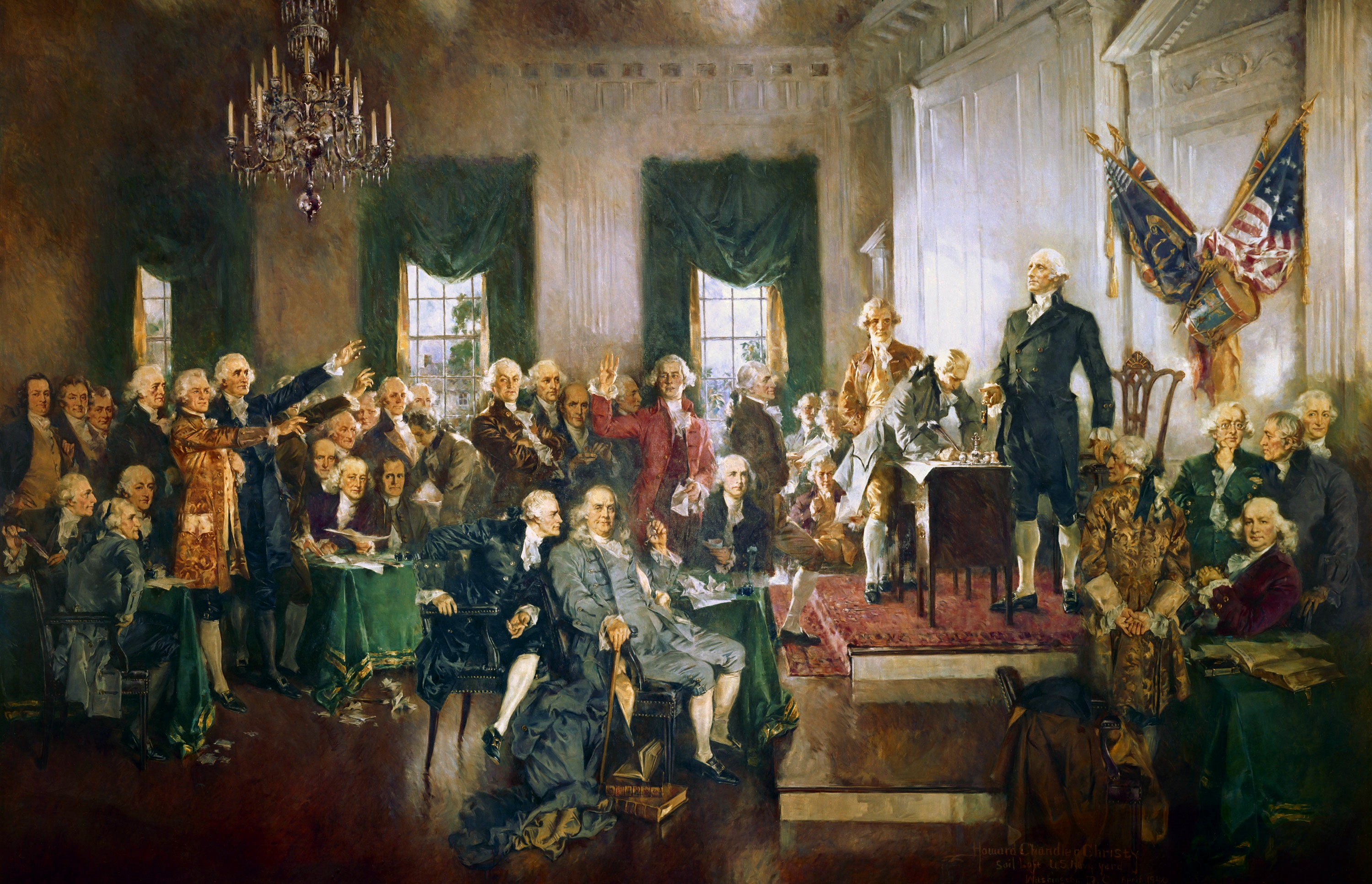 |
| Howard Chandler Christy (1873–1952) Scene from the Constitutional Convention. Source: Wikipedia Commons |
That ratio, three-fifths, made me think of a famous
three-fifths in American history, the three-fifths compromise during the US
Constitutional Convention. That
compromise gave the southern states the right to count slaves as three-fifths
of person for the purpose of political apportionment in the US Congress,
despite the fact that slaves could not be citizens, could not hold property and
could not vote.
Clearly we have moved a long way in the five generations
since the civil war that abolished slavery.
Yet the unequal support of Massachusetts community college students,
predominately low to moderate income and many of color, show that we still have
a way to go to address old patterns of power and privilege. Is there a justification for the Commonwealth
to give less state support to one group of public higher education students
compared with others? I look forward to
that debate.
Saturday, March 1, 2014
HOW TO HARNESS CREATIVITY TO IMPROVE HIGHER EDUCATION

Since the Great Recession that began in 2008, public colleges and
universities are under increased financial pressure caused by reduced state and
local government support. At the same time, private colleges and universities,
especially those who are not in the elite class - also find themselves in
financial straits as median US family income stagnates while their costs and
the cost of attendance has continued to escalate faster than overall consumer
prices. Although all of these
institutions have reacted by dramatically raising tuition and student charges,
this strategy has resulted in higher student debt and push back from students,
parents and government leaders.
To balance the books, any organization has two choices - increase
revenue or decrease costs. Most college
leaders argue that it is very difficult to do reduce or significantly moderate
the growth in expenses since their costs are driven primarily by employee
salaries that typically constitute eighty to eighty-five percent of their
budgets. Thus most Americans believe,
not incorrectly, that the cost of college, like health care, is out of control.
Many companies have discovered ways to utilize the creativity of
their employees to improve efficiency while reducing costs. The secret is to
implement an idea system that encourages employees to make suggestions of how
to change operations, usually in an area that the employee has direct knowledge
and engagement. Organizations that have
adopted idea systems include major manufacturing concerns, airlines, banks, hotels and health care organizations.
Why has higher education been resistant to this possibility? To quote Tevya from the play Fiddler on the
Roof, TRADITION. As Roger Moe, a
Minnesota State Legislator observed, " Higher education is a thousand
years of tradition wrapped in a hundred years of bureaucracy. Mr. Moe was accurate: the oldest continuing
operating university in the world is the University of Bologna founded in
1088. And even in the United States, a number of major universities trace their origins from well before the American
revolution of 1776 including: Harvard founded 1636, William and Mary 1693, St. John's College 1696,Yale University 1701, University of Pennsylvania 1740, Moravian College 1742, University of Delaware 1743 and Princeton University 1746.
Moreover, all American Institutions of higher education trace their origins to the Middle Ages witnessed by graduation ceremonies that display medieval gowns, hats and decorations.
Moreover, all American Institutions of higher education trace their origins to the Middle Ages witnessed by graduation ceremonies that display medieval gowns, hats and decorations.
Tradition takes other forms in American higher education. The
curriculum, especially that in the liberal arts harkens back to the Middle Ages
as well as the organization of these institutions with the primacy of the
faculty, the separation into distinct disciplines, the collection of credit
through a series of courses. That is not
to say that many of these traditions are useful and even essential to the
well-functioning of institutions that have survived for decades and
centuries. However, tradition
accompanied by inertia is a powerful force to resist change.
Motivated by the desire to improve the education for our students
while controlling costs, for over two years, Springfield Technical Community
College has been experimenting with an idea system. While the President of the college proposed
adopting this initiative, some cherished management views often not explicitly
stated had to be jettisoned. The most
significant was the principle that the administrators and the faculty in the
area of instruction understood how to run an effective institution. From this
perspective, the administration responsible for the institutions finances, had
the knowledge and tools to advance efficiency and find ways to control
costs. How could this not be true? A look at the pyramid below is
instructive. This diagram shows the
organization as consisting roughly of 20% managers and supervisors, and 80% of
employees who provide direct service to students and internal customers -
faculty, counselors, student support staff in the registrar's office,
admissions and financial aid, counselors, maintenance personal,
custodians. This is not an exhaustive
list but should include all employees who see individual transactions between
their departments or offices and students or other constituents including
parents.

Now here is the crucial observation. Administrators by and large do not see individual transactions, the ongoing work of the organization such as the interaction between students and faculty in the classroom, the communication about an individual application with the financial aid office and the like. Administrators see rolled up data, aggregated information such as the total number of students in a particular major, the number of students who received financial aid. If these numbers are stable or increasing, the administration is generally pleased. However, administrators, those in the twenty percent of the pyramid, are not privy to these individual transactions and therefore cannot suggest incremental improvements. The people on the front lines, the eighty percent can do that. And since they do most of the work and make up the greater part of the organization, their creativity and willingness to seize opportunities for improvement can over the long term cause improvements.
Sunday, February 23, 2014
HIGHER EDUCATION OR HIGH COST EDUCATION
A STCC engineering student and his father spoke to me recently
about transfer to a four-year engineering program. (I should explain that STCC teaches the first
two years of a standard engineering curriculum preparing students such as this
one to complete at a baccalaureate school.)
We talked about transfer choices and then the conversation turned to the
cost of college. The father explained he
had four children that he wanted to send to college. The only way that he thought he could afford
to do so was by first sending them to a local community college and then have
each transfer as juniors to a public or private four-year school.
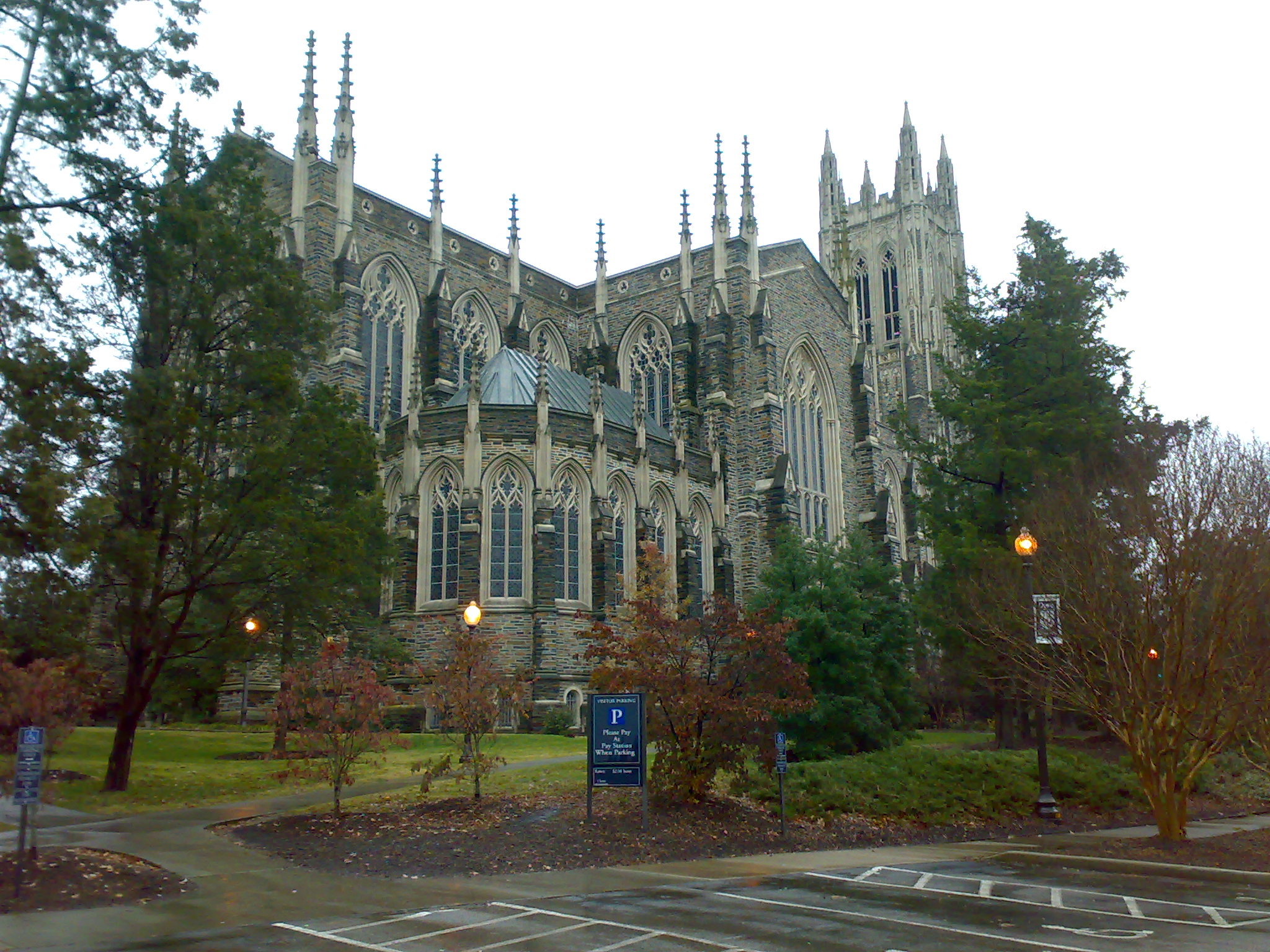 |
| Goodson Chapel, Duke University Divinity School. Source:Wikipedia |
Moreover, according to NPR, Jim Roberts, Duke’s executive vice provost, claims that the yearly cost of educating a student at Duke is $90,000. While it is difficult to ascertain the validity of Roberts’ assertion, both of these numbers should shock the typical parent in the US where the median family income is $51,000.
In fact, the Gallup poll on money worries for middle age Americans 30 to 49 lists paying for one's children’s college just behind not
having enough money for retirement and not being able to pay for medical costs
in the event of a serious illness or accident. (59% worry about cost of
college, 68% retirement and 63% medical costs)
Public colleges and universities were designed to provide a less expensive alternative than the private higher education institutions. But even here, the great recession of 2008 has forced public institutions to raise prices dramatically to make up for cuts in state funding. For example, the flagship public university in my state, the Amherst campus of the University of Massachusetts, charged $23,258 in 2013-14 consisting of $13,258 in tuition and $10,439 in room and board. While these numbers are small compared with Duke’s, tuition alone is more than a quarter of median US family income.
Community colleges with relatively low tuition costs are
perhaps the only alternative to many families. At STCC cost of attendance is $5100
per year, about 40% of tuition at UMass/Amherst, and a small fraction of a
private school like Duke. As US middle class
income stagnates and college costs inexorably rise, enrolling at a community
college and proving oneself academically has become a much more attractive path
to a college degree.
Subscribe to:
Posts (Atom)

