Showing posts with label deforestation. Show all posts

Wednesday, August 29, 2012

TROUBLE IN PARADISE AS OIL PALM REPLACES OLD GROWTH FORESTS


Oil Palm Plantation on Kalangala Island bordering on Lake Victoria

I recently returned from a visit to Kalangala on Bugula Island, the largest of the Ssese Islands in Lake Victoria, where I witnessed  the negative social and environmental effects of oil palm production.  The oil palm is a tree that produces a cluster of fruit that can be pressed to produce oil used for cooking.  Some years ago the Ugandan government entered into an agreement with BIDCO oil refineries to develop oil palm plantations on the island as well as other locations in Uganda. After talking to individuals on the island, I have come to understand that the Ugandan government transferred large tracts it controlled to BIDCO as an economic development measure sweetening the deal by giving the company a fifteen year tax break.

In Indonesia oil palm monoculture has been criticized by environmental groups because of the destruction of the native forests threatening the endangered orangutan.  Something similar is happening in Kalangala with one third of the island now covered with oil palm plantations.  Great tracks of native forests have been destroyed threatening the traditional way of life of islanders who used the forests for wood for cooking, housing and boat building. Charges of “land grabbing” have also been made as islanders have lost land that was used for generations.  Moreover, the use of fertilizer and herbicides on the oil palm plantations results in runoff to neighboring land as well as into Lake Victoria.

Finally, while on the island, I had a chance to meet and talk with some of the workers who spray herbicides to control vegetation and trees that would overwhelm the oil palms.  These young workers, recruited from around Uganda with promises of good jobs, told me:
  • They earn 3000 shillings per day, about $1.20.
  • They are expected to work every day with no time off.
  • They work without protective clothing with only boots and paper dust masks.
  • They live crowded together in company housing sleeping on the floor without mattresses, packed together like sardines.
  • Because food provided by the company and sundries from the company store are deducted, their net pay is between zero and 40,000 shillings per month, the latter being $16.00 in US currency.
Interviewing oil palm workers who spray herbicides to control vegetation.

Monday, August 6, 2012

WALKING MPANGA FOREST


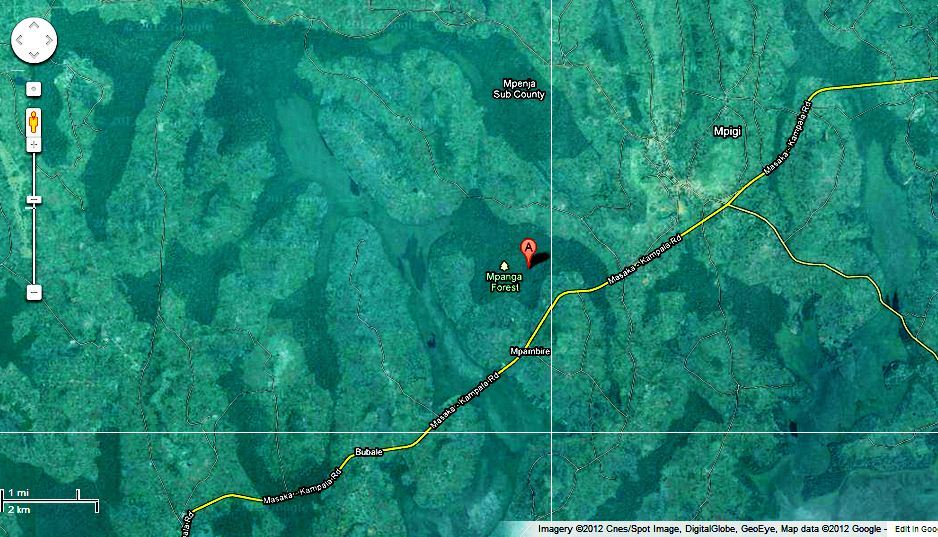
Mpanga Forest (A above) aerial view.  Note loss of forest habitat (dark green) in surrounding area.

Mpanga Forest in Mpigi, about 45 KM (25 miles) southwest of Kampala, Uganda.  Mpanga Forest is an approximately 450 hectare (1100 acre) preserve that hosts many species of butterflies, birds and monkeys. But most impressive are the trees, tall, stately, creating a rain forest canopy high above the ground.
A large fig tree in Mpanga Forest with the Author for comparison.
Unfortunately, we saw few tracts of forest on our way to Mpanga, not surprising given the rate of deforestation in Africa.  According to Wikipedia, Africa is suffering deforestation at twice the world rate, according to the United Nations Environment Programme:   Of course, Africa is not alone this is a worldwide trend and problem, one that worsens global warming by eliminating trees that soak up carbon dioxide.  Again, citing Wikipedia, “About half of the world original forests had disappeared by 2011, the majority during the last 50 years. "Since 1990 half of the rain forests have disappeared.”

Thinking about the loss of forests as we hiked through Mpanga Forest, the lyrics from Big Yellow Taxi by Joanie Mitchell came back to me:

They took all the trees
And put them in a tree museum
Then they charged the people
A dollar and a half just to see 'em
Don't it always seem to go,
That you don't know what you've got
'Til it's gone
They paved paradise
And put up a parking lot